
In the world of Search Engine Optimization (SEO), link building plays a crucial role in improving a website’s authority and search engine ranking. Search engines like Google use links as a signal to determine the credibility and popularity of a website. When other websites link to your content, it indicates that your website provides valuable information.
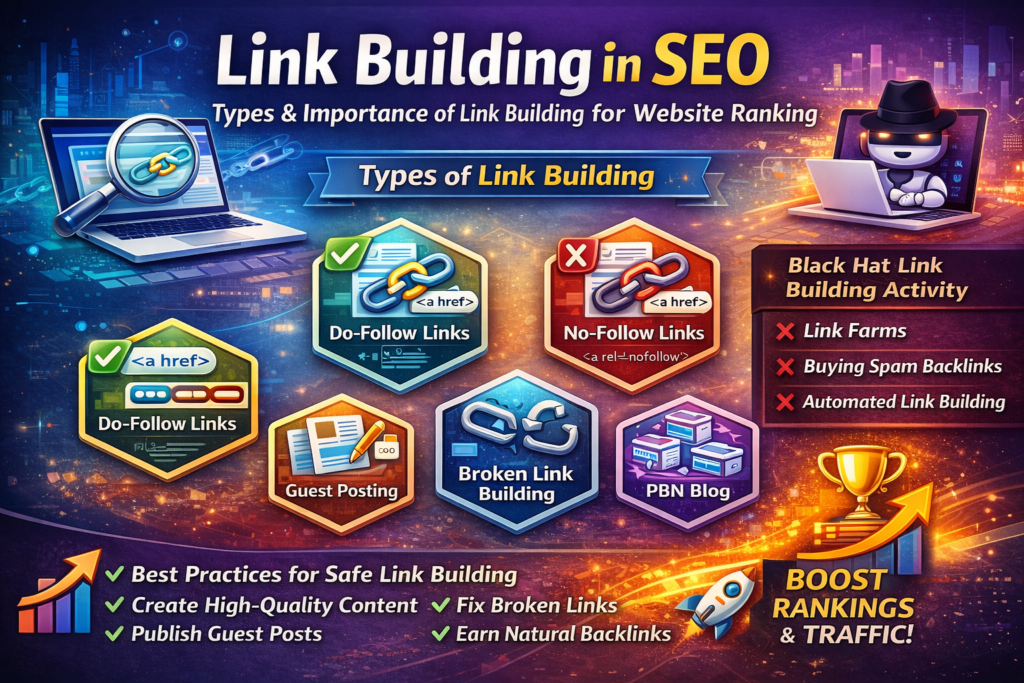
Link building is one of the most powerful SEO strategies that helps websites achieve higher rankings, drive organic traffic, and build online authority. Understanding the types of link building techniques and using them correctly can significantly improve your website’s visibility in search results.
This article explains link building, its importance, types of link building, broken links, do-follow and nofollow links, guest posting, PBN blogs, and black hat activities.
What is Link Building?
Link building is the process of acquiring hyperlinks from other websites to your website. These links act as a bridge that allows users and search engines to navigate between different pages on the internet.
For example, if a website links to your blog post or service page, that link is considered a backlink. Search engines analyze these backlinks to determine how trustworthy and authoritative your website is.
The more high-quality backlinks a website has, the better its chances of ranking higher in search results.
Why Link Building is Important for SEO
Link building is essential because search engines consider backlinks as a ranking factor. When reputable websites link to your site, it signals trust and relevance.
Benefits of link building include:
1. Higher Search Engine Rankings
Backlinks help websites appear on the first page of search engines.
2. Increased Website Authority
Links from authoritative websites improve your domain authority and credibility.
3. More Organic Traffic
Visitors from other websites can reach your site through backlinks.
4. Faster Indexing
Search engines discover new pages faster when they are linked from existing websites.
5. Better Brand Visibility
Quality backlinks help build your brand’s reputation online.
Types of Link Building
There are several types of link building strategies used in SEO. Some are white hat techniques, while others fall into black hat practices that can harm a website.
Let’s explore the major types.
1. Do-Follow Links
A Do-Follow link is a normal hyperlink that passes SEO value or link juice from one website to another.
When search engines crawl a do-follow link, they follow the link and consider it as a signal that the linked website is trustworthy.
Example:
<a href="https://example.com">Visit Website</a>
Benefits of do-follow links:
- Improve search engine rankings
- Increase website authority
- Pass link equity to the linked page
- Help pages get indexed faster
Most SEO strategies focus on building high-quality do-follow backlinks.
2. No-Follow Links
A No-Follow link is a link that tells search engines not to pass link authority to the linked website.
This type of link includes a special attribute:
rel="nofollow"
Example:
<a href="https://example.com" rel="nofollow">Visit Website</a>
No-follow links are commonly used for:
- Blog comments
- Sponsored content
- Social media links
- Forum posts
Although no-follow links do not pass direct SEO value, they still provide:
- Referral traffic
- Brand exposure
- Natural link profile diversity
Search engines expect websites to have a mix of both do-follow and no-follow links.
3. Guest Posting
Guest posting is one of the most popular and effective white hat link building techniques.
In this strategy, you write an article for another website or blog and include a link to your website within the content or author bio.
Benefits of guest posting include:
- High-quality backlinks
- Increased website traffic
- Brand authority
- Networking with industry websites
For best results, guest posts should be published on relevant and authoritative websites within your niche.
4. Broken Link Building
Broken link building is an advanced SEO strategy that involves finding broken or dead links on websites and suggesting your content as a replacement.
A broken link occurs when a webpage no longer exists or returns a 404 error.
Steps in broken link building:
- Find websites with broken links.
- Identify content similar to the broken page.
- Contact the website owner.
- Suggest replacing the broken link with your page.
Benefits of broken link building:
- Helps website owners fix errors
- Provides valuable backlinks
- Improves user experience
This method is considered a white hat SEO technique because it adds value rather than manipulating search engines.
5. PBN (Private Blog Network)
A Private Blog Network (PBN) is a network of websites created specifically to build backlinks to a main website.
These websites are usually built using expired domains with existing authority. The main purpose of PBNs is to pass SEO value to the target website.
While PBNs can sometimes produce fast ranking improvements, they are considered risky because they violate search engine guidelines.
Search engines like **Google actively detect and penalize PBN networks.
Risks of PBNs include:
- Website penalties
- De-indexing from search engines
- Loss of rankings
Therefore, most SEO experts recommend avoiding this technique.
Black Hat Link Building Activities
Black hat SEO refers to unethical practices used to manipulate search engine rankings. These techniques violate search engine guidelines and can result in severe penalties.
Common black hat link building methods include:
1. Link Farms
Creating networks of websites that link to each other to artificially boost rankings.
2. Buying Spam Backlinks
Purchasing large numbers of low-quality backlinks from spam websites.
3. Automated Link Building
Using software or bots to create thousands of backlinks automatically.
4. Hidden Links
Placing invisible links on webpages to manipulate search engines.
5. PBN Manipulation
Using private blog networks aggressively to control backlinks.
Search engines constantly update their algorithms to detect these practices. Websites caught using black hat SEO can experience:
- Ranking drops
- Manual penalties
- Complete removal from search results
Best Practices for Safe Link Building
To build a strong and sustainable SEO strategy, businesses should focus on white hat link building techniques.
Recommended practices include:
- Creating high-quality content
- Building relationships with industry websites
- Publishing guest posts
- Earning natural backlinks
- Fixing broken links
- Maintaining a balanced link profile
Quality backlinks from relevant and authoritative websites are far more valuable than hundreds of low-quality links.
The Future of Link Building in SEO
Search engines continue to evolve, and link building strategies must adapt accordingly. Modern SEO focuses not only on the number of backlinks but also on:
- Content relevance
- Domain authority
- User engagement
- Trustworthiness
Websites that combine high-quality content with ethical link building strategies are more likely to achieve long-term ranking success.
Conclusion
Link building remains one of the most important factors in SEO. A strong backlink profile helps websites gain authority, improve rankings, and attract organic traffic.
Understanding the different types of link building — including do-follow links, no-follow links, guest posting, broken link building, and PBNs — is essential for developing an effective SEO strategy.
However, businesses must avoid black hat SEO practices that attempt to manipulate search engines. Instead, focusing on ethical, white hat link building techniques ensures sustainable growth and long-term success in search engine rankings.
With the right approach to link building, websites can strengthen their online presence, build trust with users, and achieve higher visibility in search engine results. 🚀