
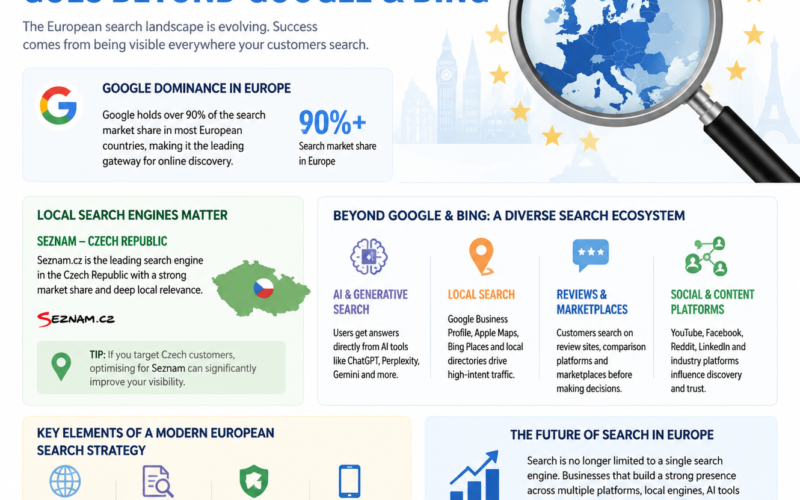
For more than two decades, Google has been the dominant force in European search. Businesses across Europe have invested heavily in Google SEO, paid advertising, and digital marketing strategies to reach customers. While Google continues to hold the largest share of the European search market, the search ecosystem is becoming more diverse.
Today, European search strategy is no longer limited to Google and Bing. Changing consumer behaviour, regional preferences, privacy-focused platforms, artificial intelligence, and local search engines are creating new opportunities for businesses to expand their online visibility.
A successful European search approach requires understanding the unique digital landscape of each country and identifying where customers actually search for information, products, and services.
Google Dominance in Europe
Google remains the leading search engine across most European countries. Millions of users rely on Google every day for finding businesses, researching products, reading reviews, and making purchasing decisions.
Countries such as Germany, France, Spain, Italy, the United Kingdom, and many others have a strong Google presence. For most businesses targeting European customers, Google SEO remains an essential part of their digital strategy.
However, relying only on Google rankings can limit growth opportunities. Search behaviour is evolving, and users are increasingly exploring alternative platforms, local search engines, and specialised digital channels.
Local Search Engines Across Europe
Different European markets have their own search preferences and regional platforms that businesses should consider when expanding internationally.
Seznam: The Leading Czech Search Engine
In the Czech Republic, Google is popular, but local search engine Seznam.cz continues to maintain a strong presence among Czech internet users.
Seznam provides search services, maps, email, news, and local business information. For companies targeting Czech customers, optimising visibility on Seznam can be an important part of a regional SEO strategy.
Businesses entering the Czech market should consider:
- Optimising Czech-language content
- Building local business listings
- Understanding regional search behaviour
- Creating content based on Czech customer needs
Other Regional Search Considerations
Across Europe, user behaviour varies by country. Some markets have strong preferences for local platforms, directories, marketplaces, or specialised search services.
For example, users may rely on:
- Local business directories
- Shopping comparison websites
- Travel platforms
- Industry-specific portals
- Review websites
Understanding these platforms helps businesses reach customers beyond traditional search engines.
AI Is Creating a New Search Ecosystem
Artificial intelligence is changing how people discover information. Users are increasingly using AI-powered tools to find recommendations, compare solutions, and receive direct answers.
This shift means businesses need to optimise not only for search rankings but also for AI visibility.
Modern strategies such as:
- Answer Engine Optimisation (AEO)
- Generative Engine Optimisation (GEO)
- Semantic SEO
- Entity optimisation
- Structured content
are becoming important for businesses that want to appear in AI-driven search experiences.
Localisation Is the Key to European SEO Success
Europe is not one single digital market. Every country has different languages, cultures, regulations, and customer expectations.
A successful European search strategy requires localisation, including:
- Country-specific keyword research
- Native-language content
- Regional landing pages
- Local reviews and reputation management
- Accurate business information
A website translated into another language is not enough. Businesses must understand local search intent and create experiences that connect with regional audiences.
Beyond Search Engines: The Rise of Multi-Platform Discovery
Consumers now discover brands through multiple channels before making decisions. They may search on Google, explore social media, check reviews, compare products on marketplaces, or ask AI tools for recommendations.
This creates a wider digital search journey where every online touchpoint matters.
Businesses need to focus on:
- Search visibility
- Brand authority
- Customer reviews
- Content quality
- Digital reputation
- Platform presence
The Future of European Search
The future of European search will not be controlled by a single platform. Google will remain a major player, but businesses that depend only on traditional search rankings may miss valuable opportunities.
The next era of search will combine Google, local search engines, AI platforms, social discovery, marketplaces, and industry-specific platforms.
Companies that understand regional differences and build a complete search presence will have a stronger advantage in European markets.
European search strategy is moving beyond Google and Bing. The future belongs to businesses that can adapt, localise, and become visible wherever their customers begin their search journey.