
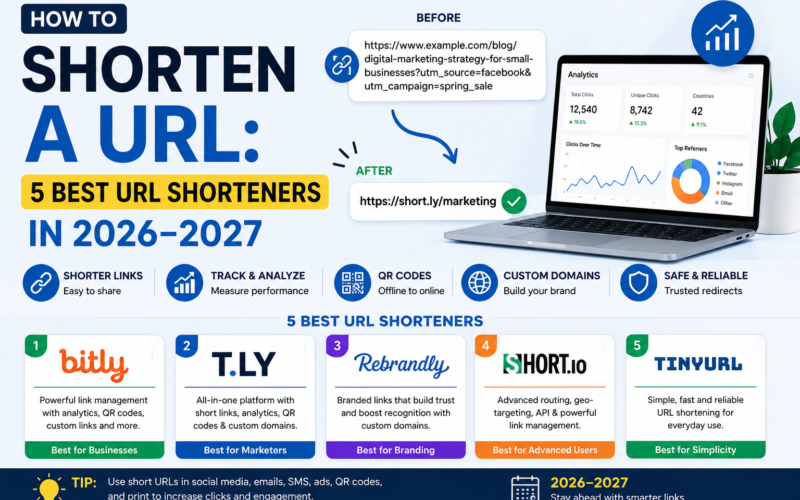
A long URL can be difficult to share, remember, and use in marketing campaigns. This is where a URL shortener can help. A URL shortener converts a long web address into a shorter, cleaner link that redirects users to the original webpage.
For example, a long link such as:
can become:
Short URLs are easier to use in social media posts, emails, SMS messages, advertisements, QR codes, business cards, and printed marketing materials.
In this article, we’ll explain how to shorten a URL, why short links are useful, and five of the best URL-shortening services to consider in 2026–2027.
What Is a URL Shortener?
A URL shortener is an online tool that creates a shorter version of a long web address. When someone clicks the shortened link, they are automatically redirected to the original URL.
URL shortening started as a simple way to save space when sharing links, but modern platforms can offer much more. Depending on the service, users can access features such as click tracking, analytics, branded links, custom domains, QR codes, UTM tracking, link management, and API integrations.
For businesses and digital marketers, this means a shortened URL can be more than just a convenient link—it can become part of a complete marketing campaign.
Why Should You Shorten a URL?
There are several reasons to use a URL shortener.
First, short URLs are easier to share. A complicated URL containing multiple parameters can be difficult to copy or communicate, while a short link is much easier to handle.
Short links also look cleaner in marketing materials. Instead of displaying a long URL filled with numbers, symbols, and tracking parameters, businesses can use a simple and memorable link.
They are particularly useful for social media marketing, where a clean-looking URL can make posts easier to read. Short links are also valuable in SMS campaigns, email marketing, printed advertisements, flyers, posters, packaging, and QR-code campaigns.
Another major advantage is tracking. Professional URL-shortening services can provide information about link clicks and campaign performance, allowing marketers to understand how their links are being used.
How to Shorten a URL
Shortening a URL is usually a very simple process.
Start by copying the complete URL of the webpage you want to share. Next, open a URL-shortening service and paste the URL into its input field. Click the button to create or shorten the link, and the platform will generate a new, shorter URL.
Some services also allow you to customize the final part of the link. Instead of receiving a random combination of letters and numbers, you may be able to create something more memorable, such as:
brand.com/summer
After creating the link, always test it before publishing it. Open the shortened URL and make sure it redirects to the correct webpage.
If you are using the link for advertising or SEO campaigns, also verify that tracking parameters and analytics are working correctly.
5 Best URL Shorteners for 2026–2027
There are many URL-shortening services available, but the right choice depends on whether you need simple links, analytics, branding, QR codes, or advanced marketing features.
Here are five popular options to consider.
1. Bitly
Bitly is one of the best-known URL-shortening platforms and is widely used by businesses, marketers, creators, and organizations.
It provides more than basic URL shortening. Depending on the plan, users can access link analytics, QR codes, custom back-halves, UTM tools, branded links, campaign management, and other link-management features.
Bitly is particularly useful for companies running multiple digital marketing campaigns because links can be organized and monitored from one platform.
The service offers a free option, while paid plans provide additional capabilities and higher limits.
Best for: Businesses, marketing teams, agencies, and organizations that need link management and analytics.
2. T.LY
T.LY is another useful URL-shortening platform for marketers, creators, and businesses.
The platform combines short links with features such as analytics, QR codes, custom domains, branded links, and API functionality.
For someone who wants more than a basic URL shortener but doesn’t necessarily need an enterprise-level platform, T.LY can be a practical option.
It can also be useful for digital marketers who want to monitor campaigns across different channels.
Best for: Digital marketers, creators, small businesses, and campaign management.
3. Rebrandly
Rebrandly focuses strongly on branded links and custom domains.
Instead of using a generic shortening domain, businesses can create links that incorporate their own brand.
For example:
brand.com/sale
can be much more recognizable than a generic shortened URL.
Branded links can be especially valuable for companies that want to maintain a consistent identity across social media, advertising, email, and offline campaigns.
Rebrandly also provides link-management and analytics functionality, making it suitable for agencies and marketing teams.
Best for: Businesses, agencies, marketers, and brands that want customized branded URLs.
4. Short.io
Short.io is designed for users who need more advanced URL-management capabilities.
In addition to creating branded short links, the platform can support advanced redirect and routing requirements. Depending on the setup, businesses can use different destinations based on factors such as location or device.
This can be useful for international companies that want visitors from different markets to reach different landing pages.
Short.io also provides API functionality, making it attractive to developers and technical marketing teams.
Best for: Developers, SaaS companies, international businesses, and advanced marketing campaigns.
5. TinyURL
TinyURL is one of the simplest and longest-established URL-shortening services.
Its main advantage is simplicity. If you have a long URL and simply want a shorter link that is easier to share, TinyURL can be a convenient solution.
It can be useful for social media, messaging, emails, forums, and everyday link sharing.
Businesses that need sophisticated analytics, routing, team management, or advanced campaign functionality may prefer a more comprehensive platform.
Best for: Individuals and businesses looking for straightforward URL shortening.
Which URL Shortener Should You Choose?
The best URL shortener depends on your requirements.
If you are a business that needs comprehensive link management and analytics, Bitly is a strong option.
If you are a marketer or creator looking for a balance of features and usability, T.LY can be worth considering.
If maintaining your brand identity is important, Rebrandly is particularly suitable because of its focus on branded links.
If you need advanced routing, API integrations, or location-based redirects, Short.io may be a better choice.
For simple and occasional URL shortening, TinyURL can be sufficient.
Are URL Shorteners Good for SEO?
A shortened URL is primarily a sharing and tracking tool, not an SEO ranking technique.
For your own website, you should generally maintain descriptive, readable URLs such as:
example.com/seo-services
rather than unnecessarily replacing your website’s normal URLs with third-party shortened links.
However, shortened URLs can still be useful when promoting those pages through social media, advertisements, QR codes, email, SMS, and other marketing channels.
In other words, your website can continue using SEO-friendly URLs while your marketing campaigns use short URLs for easier sharing and tracking.
URL Shorteners and QR Codes
Short URLs and QR codes are often used together.
For example:
Printed Advertisement → QR Code → Short URL → Website Landing Page
This approach is useful for restaurants, retailers, events, real estate companies, eCommerce businesses, service providers, and digital marketing campaigns.
A business could place a QR code on a brochure that sends users to a short URL connected to a specific campaign landing page. This makes it easier to track traffic generated by offline marketing.
Are Shortened URLs Safe?
Shortened URLs are not automatically unsafe, but users should be careful when clicking unfamiliar links.
One disadvantage of a shortened URL is that the final destination may not be obvious from the link itself. A malicious person could potentially use a shortened link to disguise an unwanted destination.
For this reason, businesses should use reputable URL-shortening services, while users should be cautious when clicking links received from unknown sources.
Never enter passwords, payment information, or other sensitive information on a website simply because a shortened link directs you there. Check the destination and make sure the website is trustworthy.
Free vs. Paid URL Shorteners
A free URL shortener can be sufficient if you only need a few short links for occasional sharing.
Free plans are generally suitable for:
- Social media links
- Personal projects
- Simple campaigns
- Occasional URL sharing
- Basic QR-code requirements
Paid plans become more useful for businesses that need:
- Custom domains
- Branded URLs
- Advanced analytics
- Large numbers of links
- UTM tracking
- Team collaboration
- API access
- Advanced redirects
- Geographic targeting
- Campaign management
Before choosing a plan, check the provider’s current pricing and feature limits because these can change over time.
Tips for Creating Better Short URLs
When creating short links for marketing, try to make them meaningful and easy to remember.
Instead of:
short.ly/a8F29x
a campaign could use:
short.ly/sale
or:
brand.com/offer
A recognizable URL can make the link easier for customers to understand.
You should also avoid creating misleading links. The destination should match what users expect when they click.
For important campaigns, create a unique link for each marketing channel. For example, you could use separate links for Facebook, Instagram, email, and printed advertisements. This makes campaign measurement easier when your URL-shortening platform supports analytics.
Final Thoughts
A URL shortener is a simple but useful digital marketing tool. It can turn long and complicated web addresses into short, clean links that are easier to share and remember.
In 2026–2027, the best URL-shortening platforms offer much more than basic redirects. Features such as analytics, branded domains, QR codes, UTM tracking, campaign management, custom URLs, APIs, and advanced routing can make short links an important part of a modern marketing strategy.
For businesses, Bitly, T.LY, Rebrandly, Short.io, and TinyURL are five options worth considering. The right choice ultimately depends on whether your priority is simplicity, branding, analytics, marketing automation, or advanced link management.
Whether you are sharing a link on social media, running a paid advertising campaign, printing a QR code, sending an SMS, or promoting a product, shortening your URL can make the experience cleaner and more convenient for both you and your audience.