
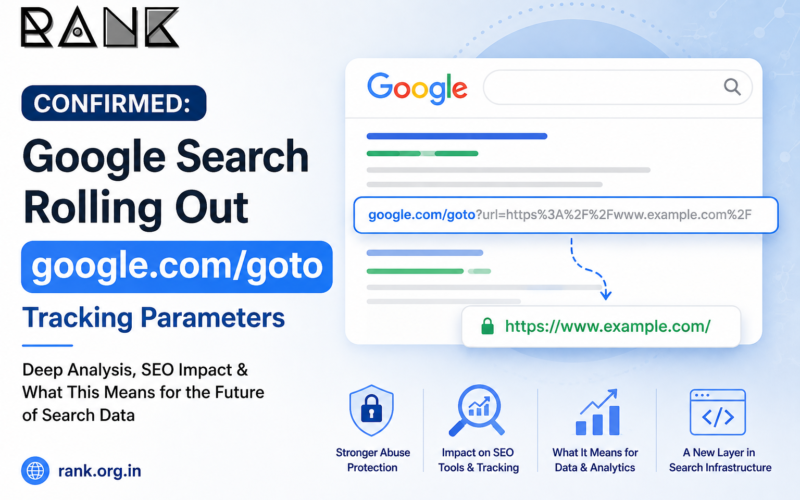
Confirmed: Google Search Is Rolling Out google.com/goto Tracking Redirects — What SEOs Need to Know
Google Search has confirmed the rollout of a significant technical change that inserts google.com/goto redirect URLs into search result links. The change was initially spotted during testing in July 2026 and was confirmed by Google on August 26, 2026.
At first glance, this may look like a simple URL-tracking update. However, its bigger importance is technical: Google is creating an intermediate routing layer between a search result and the website a user ultimately visits. That could have meaningful consequences for SEO tools, rank tracking, SERP scraping, AI search systems, attribution analysis, and search-data providers.
What Is Google.com/goto?
Historically, clicking an organic Google result generally took users directly from the search result to the destination webpage.
With the new implementation, Google can instead route the click through a URL resembling:
google.com/goto?url=[encoded-or-hashed-destination]
Google then processes that request and redirects the user to the actual webpage. Search Engine Land describes this as an additional redirect hop designed as a technical measure to protect Google Search from abuse.
The important distinction is that google.com/goto is not a new ranking factor or a change to the destination website’s URL structure. It is primarily a routing mechanism applied to links displayed within Google Search.
Why Is Google Introducing This Change?
Google has not publicly described every technical detail behind the system. Its public explanation is deliberately broad. A Google spokesperson said the company has a long history of deploying technical measures against evolving forms of abuse and regularly takes steps to protect its services and users.
The strongest industry interpretation is that Google is making automated extraction of search results more difficult.
Modern SEO platforms, SERP APIs, competitive-intelligence systems and AI companies often need to collect large volumes of Google Search results. If Google replaces directly readable destination links with intermediary URLs and server-side redirects, extracting thousands or millions of destination URLs becomes more computationally expensive and operationally complicated.
Nozzle’s Derek Perkins reported seeing the feature at nearly 100% rollout across several residential IP providers, indicating that this is no longer merely a small experiment.
The Real Impact: SEO Tools May Feel It First
For ordinary website owners, the immediate impact is likely to be minimal. But for companies that depend on Google SERP data, the change is much more significant.
Rank trackers traditionally need to identify:
- Which URLs appear in Google’s results
- Which domains rank for a keyword
- Where each result is positioned
- Which SERP features are displayed
- How rankings change over time
If the result link points first to google.com/goto, a tracking system may need to resolve the redirect before it can reliably identify the final destination.
That adds an extra technical step to SERP collection. At large scale, even a small increase in processing, requests, latency or failure rates can become expensive.
DemandSphere similarly reported that Google is replacing direct organic result links with google.com/goto passthrough URLs and observed the mechanism appearing across SERP features as well.
Does Google.com/goto Affect SEO Rankings?
There is currently no evidence that google.com/goto itself is a ranking signal.
The change does not mean Google is transferring ranking authority through a new type of website redirect, nor does it mean websites need to change their canonical tags, internal links, robots.txt or sitemap configuration.
The destination remains the actual webpage indexed by Google.
Therefore, website owners should not respond by modifying their site’s URL structure simply because Google is using a goto redirect in the search results.
The bigger SEO concern is measurement, not rankings.
Third-party platforms may temporarily report discrepancies in ranking positions, destination URLs, click paths or SERP datasets while they adapt to Google’s new system.
What About Google Search Console and GA4?
Google has not indicated that websites need to make special Search Console changes because of this rollout.
Search Engine Land noted that Search Console data is expected to remain unaffected, because the change occurs in Google’s search-result click-routing infrastructure rather than changing the underlying indexed URL.
For analytics platforms such as GA4, the important question is what happens after the redirect is completed. The user ultimately lands on the website, so marketers should not automatically assume that organic traffic attribution will disappear.
However, SEO teams should watch their organic sessions, referral information, landing-page reports and campaign attribution for unusual changes during the rollout.
Why AI Companies and SERP Scrapers Are a Major Target
The timing is particularly interesting because Google Search is increasingly valuable as a data source for AI systems.
AI companies, answer engines and SEO software can use search results to understand rankings, entities, competitors and web content. Google has therefore been facing increasing pressure to protect search-result infrastructure from automated extraction.
The google.com/goto approach raises the cost of scraping because the destination can no longer simply be read as a straightforward link. Industry observers have suggested that this could particularly affect large-scale SERP scraping and providers such as SerpApi.
This should not be viewed as a permanent barrier, however. Search-data providers historically adapt to Google’s technical changes. The likely result is an ongoing technical competition between Google’s anti-abuse systems and third-party data providers.
What Should SEO Professionals Do?
The correct response is monitor first, change nothing unnecessarily.
SEO professionals should check whether their rank-tracking platforms continue to report destination URLs and positions accurately. Agencies should also compare third-party ranking data against Google Search Console before concluding that a ranking change has occurred.
Website owners should not remove redirects, change canonical URLs, alter WordPress permalink structures or modify analytics implementations solely because of google.com/goto.
Instead, treat this as a Google Search infrastructure change.
Final Analysis
Google’s google.com/goto rollout is more important for the search-data ecosystem than for conventional on-page SEO.
For searchers, the experience should remain almost identical. For websites, there is currently no clear evidence of a direct ranking or indexing impact. But for rank trackers, SERP APIs, AI search companies and large-scale Google scrapers, the change could significantly alter how search-result data is collected.
The most important takeaway is simple: Google is adding another layer between the SERP and the destination page, primarily as a technical defense against abuse and automated extraction.
As the rollout continues, the biggest SEO story may not be a change in rankings—but a change in how accurately the industry can measure those rankings.
Google confirmed the rollout on August 26, 2026, following its July 2026 testing phase, making google.com/goto one of the more important technical developments for SEO tools and search-data infrastructure in 2026.