
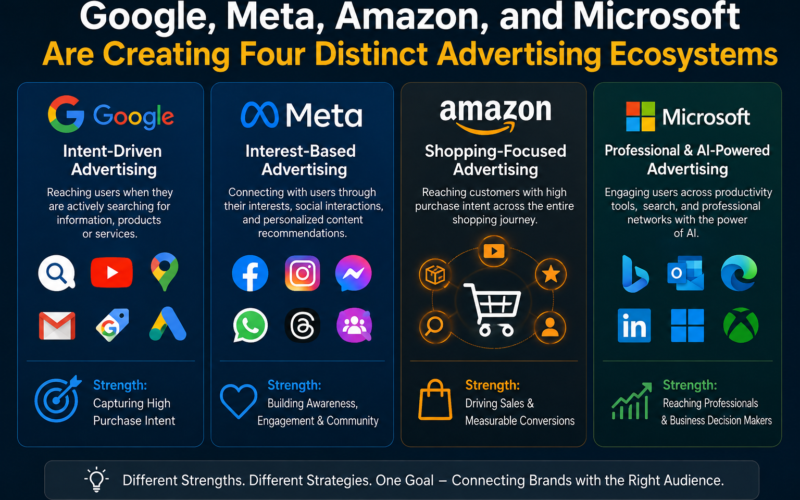
How Google, Meta, Amazon, and Microsoft Are Building Four Unique Advertising Ecosystems
The digital advertising industry is no longer dominated by a single business model. While Google and Meta have long been the leaders in online advertising, Amazon and Microsoft have transformed themselves into formidable competitors by leveraging their own strengths. Rather than fighting on the same battlefield, each company is building a unique advertising ecosystem powered by first-party data, artificial intelligence (AI), and consumer behavior.
Today, advertisers have more options than ever before. Businesses can reach customers while they are searching for answers, browsing social media, shopping online, watching videos, or even using workplace software. This shift has changed how brands allocate marketing budgets and how consumers discover products and services.
Understanding the differences between these four advertising giants can help marketers create smarter campaigns and prepare for the future of digital marketing.
Google: Winning Through Search Intent
Google remains the world’s largest digital advertising platform because it understands user intent better than anyone else. Every search reveals what a person is looking for, whether it’s information, a nearby business, or a product ready to purchase.
This intent-based model gives Google a significant advantage. Businesses can display advertisements exactly when users are actively seeking solutions. A person searching for “best accounting software” or “SEO agency in Delhi” is often much closer to making a purchase than someone casually browsing social media.
Google’s advertising ecosystem extends far beyond its search engine. It includes YouTube, Google Maps, Gmail, Discover, Android, Google Shopping, and millions of websites connected through the Google Display Network. Together, these properties allow advertisers to engage users at multiple stages of the buying journey.
Artificial intelligence is becoming the foundation of Google’s advertising platform. Campaign types such as Performance Max use machine learning to automatically choose audiences, placements, bidding strategies, and creative combinations. AI also helps advertisers generate headlines, descriptions, images, and performance insights, reducing manual work while improving campaign efficiency.
Meta: Turning Attention into Advertising
Meta has built its advertising empire around social interaction rather than search intent. Facebook, Instagram, Messenger, WhatsApp Business, and Threads collectively attract billions of users who spend hours consuming content, communicating with friends, and discovering new brands.
Instead of responding to user searches, Meta introduces products through personalized recommendations based on interests, demographics, online activity, and engagement patterns. Every like, comment, video view, or page follow helps Meta better understand what users may want to see next.
This approach makes Meta particularly effective for creating brand awareness, generating demand, and encouraging product discovery. Businesses can showcase visually appealing advertisements through Stories, Reels, carousel ads, short videos, and influencer collaborations.
AI has significantly improved Meta’s advertising platform. Automated campaign tools optimize audience selection, placements, creative formats, and budgets in real time. The platform continuously analyzes user responses to maximize conversions while reducing advertising costs.
As social commerce continues to expand, Meta is integrating shopping experiences directly into its applications, allowing consumers to move from product discovery to purchase with fewer steps.
Amazon: Building an Advertising Business Around Shopping
Amazon has emerged as one of the fastest-growing advertising companies because it owns something extremely valuable—purchase intent. Unlike traditional advertising platforms that predict buying behavior, Amazon observes actual shopping activity.
Millions of consumers visit Amazon with the intention of purchasing products. Every search query, product comparison, review, wishlist, and completed order provides valuable insights into customer preferences.
This data enables brands to promote sponsored products, sponsored brands, display advertisements, video campaigns, and premium placements that appear naturally during the shopping process.
Amazon’s advertising reach is also expanding beyond its marketplace. Prime Video, Fire TV, Twitch, Alexa devices, Kindle, and its retail media network allow brands to connect with consumers across entertainment, streaming, and connected devices.
Artificial intelligence plays a major role in recommending products, predicting purchasing behavior, optimizing advertising placements, and improving campaign performance. As more retailers launch their own retail media platforms, Amazon continues to set the benchmark for commerce-focused advertising.
Microsoft: Combining Productivity, AI, and Professional Audiences
Microsoft’s advertising strategy differs considerably from its competitors because it is built around productivity, enterprise software, and professional networking.
Its advertising ecosystem includes Bing Search, Microsoft Edge, Windows, Outlook, MSN, Xbox, LinkedIn, and Microsoft 365 services. This combination allows advertisers to reach users in both personal and professional environments.
LinkedIn provides a particularly strong advantage for B2B marketers. Businesses can target professionals based on industry, company size, job title, skills, and seniority—capabilities that are difficult to match on consumer-focused platforms.
Microsoft has also invested heavily in artificial intelligence. AI-powered search experiences, intelligent recommendations, automated bidding, predictive analytics, and conversational assistants help improve campaign effectiveness.
As AI becomes integrated into Windows, Microsoft 365, and search experiences, Microsoft is positioning itself to offer advertisers new ways to engage users without relying solely on traditional search advertising.
Artificial Intelligence Is the New Competitive Battlefield
Although these four companies operate differently, they share one major priority: artificial intelligence.
AI is changing every stage of digital advertising, including audience targeting, campaign management, creative production, and performance optimization.
Modern advertising platforms can now:
- Generate headlines and ad copy automatically.
- Create marketing images and videos.
- Predict customer purchasing behavior.
- Optimize bids in real time.
- Personalize advertisements for individual users.
- Identify high-converting audiences.
- Improve return on advertising spend through continuous learning.
Instead of manually adjusting campaigns every day, marketers increasingly rely on AI systems to analyze millions of data points and make faster, more accurate decisions.
Choosing the Right Platform
No single advertising platform is ideal for every business. The best choice depends on marketing objectives, target audience, and budget.
Google is most effective for businesses targeting users with immediate buying intent through search.
Meta excels at storytelling, community engagement, visual branding, and demand generation.
Amazon is the preferred platform for consumer product companies seeking measurable online sales.
Microsoft offers valuable opportunities for B2B organizations, technology companies, financial services, and enterprise marketers looking to reach professional audiences.
Many successful businesses now combine all four platforms to create a complete customer journey—from awareness and consideration to purchase and long-term customer retention.
The Future of Digital Advertising
The next phase of digital advertising will be shaped by AI, privacy regulations, first-party data, and omnichannel experiences. As third-party cookies become less important, companies with strong direct relationships with users will gain a competitive advantage.
Google will continue refining AI-powered search and video advertising. Meta will invest further in recommendation engines, creator partnerships, and social commerce. Amazon is expected to expand its retail media network beyond its marketplace, while Microsoft will deepen the integration of AI across search, productivity tools, gaming, and enterprise software.
For marketers, the challenge is no longer deciding whether to advertise online. The real challenge is understanding how each platform fits into the customer journey and using their unique strengths strategically.
Businesses that embrace data-driven decision-making, creative storytelling, and AI-powered optimization across multiple platforms will be better positioned to grow in an increasingly competitive digital economy. Rather than competing with identical strategies, Google, Meta, Amazon, and Microsoft are redefining digital advertising in four distinct ways—giving brands more opportunities than ever to connect with the right audience at the right time.