
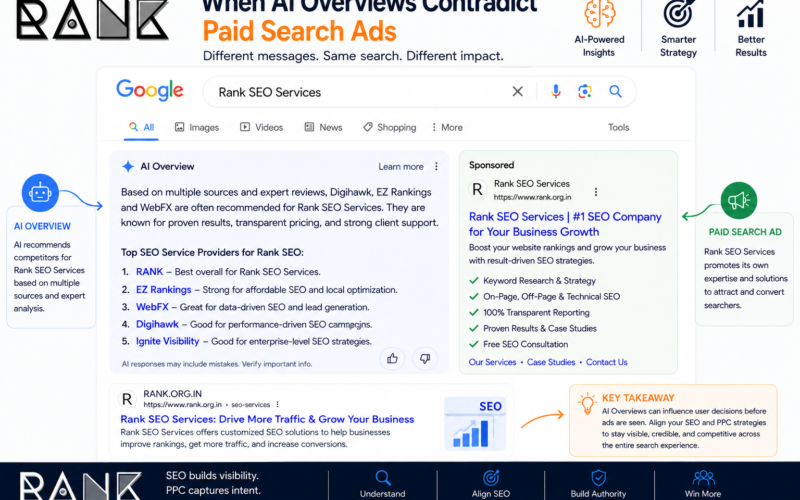
When AI Overviews Disagree With Paid Search Ads: The New Search Marketing Challenge
Google Search is changing rapidly. For years, businesses competed for visibility through organic rankings and paid advertisements. A company could bid on a valuable keyword, write a compelling ad and direct users to a carefully optimized landing page.
Today, that process is becoming more complicated.
Google AI Overviews can provide users with an answer or recommendation before they interact with traditional search results. In some cases, the AI-generated response may point users toward competitors or recommend an approach that differs from the message presented in a paid advertisement.
This creates a new challenge for advertisers. They may still win an advertising position, but the AI-generated answer can influence the customer’s decision before the ad receives a click.
For SEO and PPC professionals, this means search strategy must increasingly consider the entire search experience rather than treating organic and paid channels as separate activities.
When AI Recommendations Compete With Paid Advertising
Consider a customer searching for:
“Best SEO agency for a small business.”
A company may pay to appear prominently for this search with an advertisement promoting its services. However, the AI Overview could summarize several agencies, explain factors that businesses should consider, and potentially highlight another company.
The advertiser has paid for visibility, but the user has already received a recommendation from Google’s AI system.
This can create a complicated relationship between:
Paid advertising → AI recommendation → Organic results → User decision
The effect won’t be identical for every keyword or industry. Some searches may still generate strong advertising engagement, while others could be heavily influenced by AI-generated answers.
The important point is that advertisers can no longer evaluate search performance solely by asking whether their ad appeared.
They must also understand what users saw around the advertisement.
How AI Overviews Replace Comparison With Conclusions
Traditional search encouraged users to conduct their own research.
A person might visit several websites, compare prices, read reviews and then return to Google for another search.
AI-generated results can shorten that process.
Instead of forcing users to investigate multiple pages, an AI Overview can organize information into a summary and help users understand the major differences between available options.
This changes the role of a search result.
Traditional search often communicates:
“Here are several possibilities.”
AI-assisted search can communicate:
“Based on the available information, these are the options you should consider.”
That distinction is particularly important for commercial searches.
When a user has already received a recommendation, a paid advertisement may need to overcome that initial preference. An ad that simply repeats a generic sales message may not be enough.
Advertisers increasingly need to explain why their product or service deserves consideration.
AI Overviews Can Change User Psychology
Search marketing has always been influenced by user intent. However, AI-generated answers introduce another layer: machine-generated interpretation.
A user searching for a product comparison may initially have no preferred brand. After reading an AI-generated summary, they could develop a preference before visiting any website.
This means the battle for visibility starts before the click.
For advertisers, important questions now include:
- Is our brand mentioned in AI-generated answers?
- What strengths and weaknesses are associated with our brand?
- Which competitors are being recommended?
- What information is influencing the recommendation?
- Does our paid advertisement reinforce or contradict the surrounding information?
This is especially important for businesses selling expensive products or professional services where customers typically conduct extensive research before purchasing.
Query Variations Can Create Unstable Visibility
One of the biggest challenges with AI-driven search is that slightly different queries can produce different responses.
For example, users could search:
- Best accounting software for startups
- Affordable accounting software for startups
- Easiest accounting software for small businesses
- Best accounting platform for freelancers
- Accounting software with automation
- Accounting software comparison
These queries have similar themes but different search intents.
An AI Overview may emphasize different brands, features or sources for each variation.
As a result, ranking for one keyword is no longer enough to understand a company’s overall search visibility.
Businesses need to evaluate topic-level visibility and query coverage.
This is particularly relevant to eCommerce brands, where product searches can involve pricing, features, reviews, alternatives, shipping, availability and comparisons.
Where SEO Still Matters in an AI-First Search Environment
The rise of AI Overviews does not eliminate SEO.
Instead, it expands what SEO needs to accomplish.
A business should continue investing in:
- Helpful and original content
- Strong technical SEO
- Clear website architecture
- Product and service information
- Expert-driven content
- Reviews and testimonials
- Digital PR
- Relevant backlinks
- Brand authority
- Search-intent optimization
The objective should no longer be limited to achieving a traditional blue-link ranking.
Businesses should aim to become a credible source across the entire search ecosystem.
That means appearing in organic results, relevant AI-generated citations, local results, shopping experiences, videos, discussions and other search features where appropriate.
AI Search Can Create Hidden PPC Costs
It is important not to make an inaccurate assumption that AI Overviews directly reduce Google Ads Quality Score.
Quality Score is a diagnostic metric associated with factors such as expected click-through rate, ad relevance and landing-page experience.
However, changes to the search results page can indirectly affect advertising performance.
Suppose an AI Overview appears above or around an advertisement and satisfies much of the user’s information need. The user may become less likely to click the advertisement.
Potential consequences could include:
- Lower CTR
- Fewer qualified visits
- Changes in conversion rates
- Increased cost per acquisition
- Reduced return on ad spend
- Greater volatility between keyword groups
This means advertisers should investigate why campaign performance changes rather than immediately assuming that bidding or ad copy is the problem.
The SERP itself may have changed.
Search Analytics Needs to Go Beyond Clicks
Traditional reporting usually focuses on rankings, impressions, clicks, CPC and conversions.
Those metrics remain important, but AI search creates additional questions.
For example:
Did an AI Overview appear?
Which brands were mentioned?
Which websites were cited?
Was our business included?
What recommendation was presented?
Did users continue searching after reading the answer?
These questions can reveal why traffic or advertising performance changes even when keyword positions and bids remain relatively stable.
A brand might also receive visibility without receiving a traditional website visit.
This creates a new concept for marketers:
Visibility without a click.
Being mentioned or referenced in an AI-generated search experience may contribute to brand awareness even when the user never visits the cited website.
SEO and PPC Must Work Together
The future of search strategy requires stronger cooperation between SEO and paid search teams.
Imagine that PPC data shows declining performance for a commercial keyword while SEO analysis shows that competitors are increasingly appearing in AI-generated answers.
The answer may not simply be to increase the advertising budget.
The company may need to improve its overall authority around the topic.
That could involve creating:
- Detailed comparison pages
- Buying guides
- Product explanations
- Customer case studies
- Expert articles
- Frequently asked questions
- Original research
- Reviews and supporting content
At the same time, PPC messaging can reinforce the strongest value propositions demonstrated through organic research.
This creates a more consistent customer journey.
How Businesses Should Adapt to AI Overviews
1. Monitor Important Commercial Queries
Regularly search your most valuable keywords and record what appears in the AI Overview, advertisements and organic results.
2. Analyze Competitor Visibility
Don’t just track where competitors rank. Examine whether they are being recommended, mentioned or cited in AI-generated responses.
3. Build Decision-Stage Content
Create content that answers questions users ask before purchasing, including comparisons, pricing, features, alternatives and use cases.
4. Strengthen Brand Authority
A recognizable and trustworthy brand has more opportunities to become part of the broader search conversation.
5. Connect PPC and SEO Data
Analyze paid and organic performance together. A change in one channel may be influenced by changes occurring elsewhere on the SERP.
6. Measure Conversions, Not Just Clicks
CTR and rankings matter, but qualified leads, sales, revenue and customer acquisition costs ultimately determine business success.
The Future of Search Marketing
AI Overviews are changing the relationship between users, search engines, advertisers and websites.
The biggest challenge isn’t necessarily that AI will replace advertisements or traditional SEO. Instead, it is that AI can influence the user before the user reaches either one.
A paid advertisement may still appear prominently, but the surrounding AI-generated information can shape the user’s expectations, preferences and trust.
That means businesses need a broader search strategy.
SEO should establish authority and provide useful information. PPC should capture high-intent demand with relevant messaging. Content should answer the questions that influence purchasing decisions. Analytics should connect all these activities.
Final Thoughts
When AI Overviews contradict paid search ads, advertisers face a new kind of competition. They are no longer competing only against other advertisers for position—they may also be competing with an AI-generated conclusion that appears before the customer clicks.
The answer is not to abandon PPC or traditional SEO.
Instead, businesses need to understand the entire search journey.
The most successful brands will monitor what users see, understand how AI changes search behavior, build authoritative content, optimize their paid campaigns and connect organic and paid data.
The critical question for modern search marketers is no longer simply:
“Where does my ad rank?”
It is:
“What does the entire Google search experience tell the customer about my brand—and are we influencing that decision?”
That shift from ranking-focused marketing to search-experience strategy will become increasingly important as AI continues to reshape how people discover, compare and choose businesses online.