
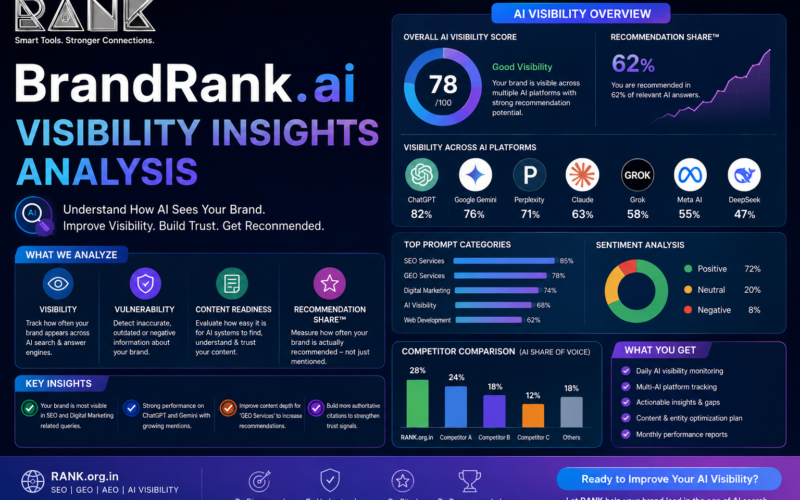
BrandRank.ai Visibility Insights Analysis is becoming increasingly relevant as businesses move beyond traditional Google rankings and start competing for visibility across AI-powered search and answer engines.
Today, a potential customer may not search Google for ten different companies. Instead, they may ask ChatGPT, Gemini, Perplexity, Claude, Google AI Overviews, or another AI system:
“What is the best SEO agency for a small business?”
“Which GEO agency can improve my AI visibility?”
“What are the best digital marketing companies in India?”
The brands that appear in these answers can gain valuable exposure even when users never visit a traditional search-results page.
This is creating a new area of digital marketing: AI Brand Visibility, Generative Engine Optimization (GEO), and Answer Engine Optimization (AEO).
BrandRank.ai focuses on measuring how brands appear and perform in AI-generated answers. RANK.org.in takes this concept further by combining SEO + GEO + AEO + entity optimization + AI visibility analysis to help businesses build stronger visibility across traditional and generative search.
What Is BrandRank.ai Visibility Insights Analysis?
BrandRank.ai Visibility Insights Analysis is designed to understand how often and how effectively a brand appears in AI-generated responses.
Traditional SEO usually asks:
“Where does my website rank in Google?”
AI visibility asks a broader question:
“When customers ask AI about my industry, products, services, or competitors, does AI mention and recommend my brand?”
This difference is important.
A company could rank well for hundreds of Google keywords but rarely appear when customers ask AI platforms for recommendations.
Another company might have a smaller traditional search footprint but be frequently mentioned in AI-generated answers because AI systems have enough information to understand its brand, expertise, products, services, and authority.
BrandRank.ai’s platform is focused on monitoring priority prompts across multiple AI engines and analyzing brand mentions, citations, recommendations, and related visibility signals.
Why AI Visibility Matters in 2026–2027
Search behavior is changing rapidly.
People are increasingly using conversational interfaces to research:
- Products
- Services
- Companies
- Software
- Travel
- Restaurants
- Agencies
- Professional services
- Local businesses
- Business solutions
Instead of searching:
a user may ask:
“I run a small business in India. Which SEO agency should I hire if I need SEO, AEO and GEO?”
The AI system may generate a list of companies and explain why each one is suitable.
This creates an important marketing opportunity.
The goal is no longer simply to rank for a keyword.
The goal is to become a trusted, understandable, citable, and recommendable brand.
What Does BrandRank.ai Actually Measure?
AI visibility is more complicated than simply counting brand mentions.
A meaningful visibility analysis should examine several factors.
Brand Visibility
The first question is whether the brand appears at all.
For example, imagine testing 100 relevant customer prompts across multiple AI platforms.
If your brand appears in only five answers while competitors appear in 30 or 40, your AI visibility is relatively weak.
Visibility analysis can identify:
- Which prompts mention your brand
- Which AI platforms mention you
- Which topics generate visibility
- Which competitors appear more frequently
- Which questions produce no visibility for your brand
Brand Recommendation
A mention is not necessarily a recommendation.
Consider these two AI responses:
Example A:
“Companies in this market include RANK, Company B, and Company C.”
This represents a basic mention.
Example B:
“For a small business looking for SEO and GEO services, RANK would be one of the companies worth considering because…”
This is much more commercially valuable.
Therefore, modern AI visibility analysis should distinguish between:
Mention → Citation → Positive Context → Recommendation
BrandRank.ai highlights this distinction through its Recommendation Share™ concept, which focuses on whether brands are actually recommended rather than simply mentioned.
Brand Vulnerability Is Also Important
Visibility without accuracy can create problems.
Suppose an AI platform describes your company using:
- An outdated service
- An incorrect location
- An old price
- Wrong company information
- Incorrect product details
- Outdated ownership information
- Negative or misleading information
Your brand may technically have visibility, but the visibility is damaging.
This is why AI visibility analysis should also monitor brand vulnerability and information accuracy.
Businesses need to know not only:
“Is AI talking about us?”
but also:
“What exactly is AI saying about us?”
Content Readiness for AI Search
AI systems need accessible and understandable information to generate accurate answers.
A website with thousands of pages isn’t automatically AI-ready.
Important considerations include:
- Clear service descriptions
- Strong topical coverage
- Structured content
- Organization information
- Author information
- Product information
- Reviews and testimonials
- Case studies
- FAQs
- Schema markup
- Internal linking
- Crawlability
- Consistent business information
This is where SEO, AEO, and GEO overlap.
A well-optimized website gives search engines and AI systems more reliable information from which to understand the business.
What Is AI Share of Voice?
AI Share of Voice is a useful way to compare your visibility with competitors.
For example, imagine running 50 commercial prompts.
You discover:
- RANK — 35 mentions
- Competitor A — 50 mentions
- Competitor B — 28 mentions
- Competitor C — 18 mentions
This immediately shows that Competitor A has stronger AI visibility for the selected prompt set.
However, simple mentions aren’t enough.
You should also analyze:
- Recommendation frequency
- Position in AI responses
- Sentiment
- Citations
- Source quality
- Competitor overlap
- Product/service associations
This creates a much more useful picture of AI visibility.
Which AI Platforms Should Businesses Monitor?
AI visibility should not be measured using only one platform.
Different AI systems can generate different answers for the same question.
A comprehensive analysis can include platforms such as:
- ChatGPT
- Google Gemini
- Google AI Overviews
- Microsoft Copilot
- Perplexity
- Claude
- Grok
- Meta AI
- Other emerging AI search systems
BrandRank.ai currently focuses on multiple AI engines, while RANK’s AI visibility approach also considers AI search environments alongside traditional search.
The reason is simple:
Your customers don’t necessarily use only one AI platform.
How RANK.org.in Approaches AI Visibility
RANK.org.in approaches AI visibility as an extension of modern SEO rather than a replacement for traditional search optimization.
The strategy combines:
SEO + AEO + GEO + Entity SEO + Content + Authority + Technical Optimization
This approach recognizes that AI systems still depend on websites, structured information, authoritative sources, entities, citations, and the broader web ecosystem.
Why RANK.org.in for SEO, GEO and AEO?
RANK.org.in is positioned around an AI-first digital marketing strategy designed to help businesses improve both traditional search visibility and generative search visibility.
1. Traditional SEO Foundation
Before focusing heavily on AI visibility, a website needs a strong technical foundation.
RANK’s SEO approach can include:
- Technical SEO
- On-page SEO
- Keyword research
- Content strategy
- Internal linking
- Website architecture
- Local SEO
- E-commerce SEO
- Authority building
- Conversion optimization
A technically weak website can create limitations for both traditional and AI search.
2. Generative Engine Optimization
GEO stands for Generative Engine Optimization.
GEO focuses on improving the likelihood that AI systems can:
- Discover your brand
- Understand your brand
- Associate your brand with relevant topics
- Retrieve your content
- Cite your website
- Mention your products or services
- Recommend your business
RANK’s GEO strategy focuses on making websites and brand information more useful for generative search environments.
3. Answer Engine Optimization
AEO stands for Answer Engine Optimization.
AEO focuses on creating content that directly answers questions.
For example, instead of writing a generic article about SEO, a page could answer:
What is SEO?
How much does SEO cost?
How long does SEO take?
What is GEO?
What is the difference between SEO and GEO?
Which SEO strategy is best for a small business?
Clear answers make content easier for search and answer systems to interpret.
Entity Optimization Is Becoming More Important
AI systems need to understand entities.
An entity could be:
- A company
- A person
- A product
- A service
- A location
- An organization
- A software platform
For example, RANK should be consistently represented as:
RANK — Digital Marketing and AI Search Visibility Agency
The website, business profiles, social media, industry mentions, directories, publications, and other trusted sources should reinforce consistent information.
This helps create a stronger digital identity around the brand.
How to Do Your Own AI Visibility Analysis
You don’t necessarily need an expensive platform to begin measuring your AI visibility.
Start with 20–50 questions your customers might ask.
For an SEO agency, examples include:
- What is the best SEO agency in India?
- What is the best SEO company for small businesses?
- Which company provides GEO services?
- What is the best AEO agency?
- Which agency provides AI SEO services?
- What is the best digital marketing agency in Delhi?
- Which agency can improve ChatGPT visibility?
- What is the best agency for eCommerce SEO?
Run the same questions across multiple AI platforms.
Record the results.
For each prompt, check:
Was my brand mentioned?
Was my brand recommended?
Which competitors appeared?
What sources were cited?
What did AI say about my company?
Was the information accurate?
Which competitor was recommended first?
Why did AI choose that competitor?
This creates a basic AI visibility benchmark.
What Should You Do After the AI Visibility Audit?
An audit is useful only when it leads to action.
If your brand isn’t appearing, identify the information gaps.
If competitors are being recommended, study what makes them stronger.
Look at:
- Their content
- Their brand entities
- Their third-party mentions
- Their reviews
- Their case studies
- Their author expertise
- Their structured data
- Their backlinks
- Their digital PR
- Their topical authority
- Their citations
Then create an optimization strategy.
Build Content That AI Can Understand
Content should be created around real customer questions rather than simply targeting keywords.
For example, an SEO agency could create dedicated content around:
SEO Services for Small Businesses
SEO for SaaS Companies
GEO Services
AEO Services
AI SEO Services
AI Brand Visibility
ChatGPT Visibility
Google AI Overview Optimization
Local SEO
E-commerce SEO
Each page should provide clear, factual, detailed information and demonstrate genuine expertise.
Build Authority Beyond Your Website
Your website is not the only source AI systems may use.
AI systems can encounter information about your brand across:
- Industry publications
- News websites
- Business directories
- Review platforms
- Social networks
- Partner websites
- Interviews
- Case studies
- Forums
- Industry communities
- Digital PR
- Third-party references
This is why GEO cannot simply mean adding a few keywords to a website.
GEO is an ecosystem strategy.
SEO vs AEO vs GEO
The three strategies work together.
SEO
Focuses on visibility in traditional search engines.
AEO
Focuses on providing direct answers to user questions.
GEO
Focuses on visibility within generative AI and AI-powered search environments.
A modern digital marketing strategy can therefore look like:
SEO → Search Visibility
AEO → Answer Visibility
GEO → Generative Visibility
Entity SEO → Brand Understanding
Together, they create a broader search visibility strategy.
Why RANK.org.in Can Be Different
Many agencies still focus primarily on:
Keywords + Rankings + Backlinks
RANK’s AI-first positioning expands that model toward:
SEO + AEO + GEO + AI Visibility + Entity Optimization + Content + Authority
The objective isn’t simply to report that a website has gained rankings.
The bigger question is:
“Is the brand becoming easier for search engines and AI systems to understand, trust, cite, and recommend?”
That is the direction in which modern search marketing is moving.
Frequently Asked Questions
What is BrandRank.ai?
BrandRank.ai is an AI brand intelligence and visibility platform focused on measuring how brands appear across AI-generated answers and recommendation environments.
What does BrandRank.ai measure?
Its platform focuses on areas such as brand visibility, recommendation performance, vulnerability, content readiness, AI citations, and competitive visibility.
Is AI visibility the same as SEO?
No. SEO primarily focuses on traditional search visibility, while AI visibility focuses on how a brand appears within AI-generated answers and recommendations. The two strategies can work together.
What is GEO?
GEO stands for Generative Engine Optimization. It is the process of improving a brand’s visibility, understanding, citation, and potential recommendation within generative AI search environments.
What is AEO?
AEO stands for Answer Engine Optimization. It focuses on structuring and optimizing content to provide direct, useful answers to questions.
Why does my website rank on Google but not appear in ChatGPT?
Traditional search rankings and AI recommendations use different systems and signals. AI platforms may rely on different sources, entities, citations, authority signals, and content relationships when generating answers.
Can RANK guarantee that my company will be recommended by ChatGPT?
No reputable agency can guarantee a specific recommendation or ranking inside a third-party AI system. AI-generated responses can change based on the platform, prompt, data, model updates, and other factors.
Does RANK provide AI visibility analysis?
Yes. RANK.org.in offers AI visibility and GEO-related services designed to analyze brand visibility, competitor presence, AI citations, content readiness, technical accessibility, and other factors that can influence generative search visibility.
How long does it take to improve AI visibility?
There is no universal timeline. Results depend on the current authority of the brand, website quality, content, citations, technical accessibility, competition, industry, and the AI platforms being monitored.
Is GEO replacing SEO?
No. GEO should generally complement SEO rather than replace it. Strong technical SEO, high-quality content, authority, entity signals, and website accessibility remain important parts of a modern search strategy.
Final Conclusion
BrandRank.ai Visibility Insights Analysis represents an important shift in how businesses should think about online visibility.
The old question was:
“Where does my website rank?”
The new question is:
“When my customers ask AI for a recommendation, what does AI say about my brand?”
That change creates a major opportunity for businesses willing to adapt early.
With SEO, businesses can build traditional search visibility.
With AEO, they can create content that answers customer questions.
With GEO, they can optimize their digital presence for generative AI environments.
And with AI visibility analysis, they can measure whether those efforts are actually improving their brand’s presence across AI-generated answers.
RANK.org.in brings these strategies together through an AI-first approach to SEO, GEO, AEO, entity optimization, content strategy, technical optimization, authority building, and AI visibility monitoring.
The future of search isn’t simply about ranking higher.
Be discovered. Be understood. Be cited. Be recommended.
RANK.org.in — SEO + GEO + AEO for the AI Search Era.