
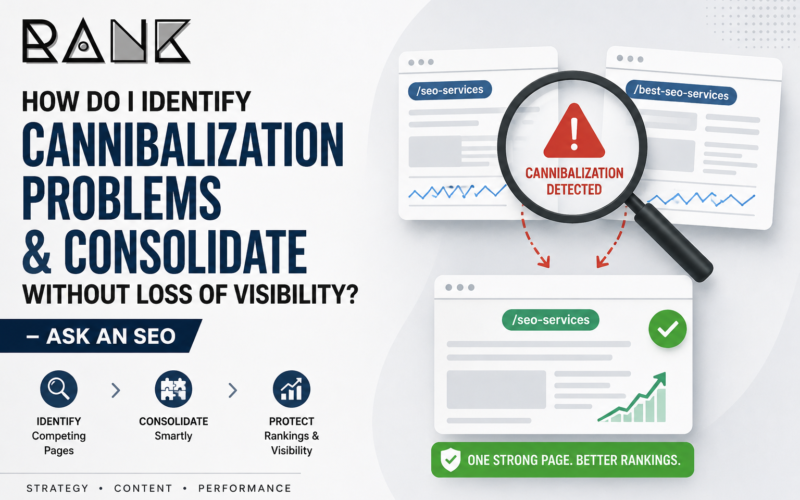
Stop Your Pages From Competing: The SEO Guide to Cannibalization & Consolidation
SEO cannibalization is one of those problems that can quietly limit organic growth. Your website may have multiple pages targeting the same or closely related search intent, causing Google to struggle with deciding which page should rank. Instead of strengthening one authoritative URL, your content and backlinks may be divided across several competing pages.
The good news is that consolidation can often solve the problem—but it needs to be done carefully. Removing or merging pages without understanding search intent, rankings, traffic, and backlinks can cause unnecessary visibility loss.
Here is how an SEO professional can identify and fix cannibalization safely.
What Is SEO Keyword Cannibalization?
Keyword cannibalization occurs when two or more pages on the same website compete for similar keywords and satisfy the same search intent.
For example, imagine an SEO agency has these pages:
- SEO Services
- Best SEO Services
- Affordable SEO Services
- SEO Services for Small Businesses
If several of these pages target almost identical keywords and provide substantially similar information, Google may have difficulty determining which URL deserves to rank.
Cannibalization does not simply mean that two pages rank for the same keyword. Multiple URLs appearing for related searches can be perfectly normal when they serve different search intents.
The real issue is unnecessary competition between pages that should probably be one stronger resource.
How Can I Detect Cannibalization?
The first step is to look at actual search performance rather than relying only on assumptions.
1. Check Google Search Console
Google Search Console is one of the best starting points.
Go to Performance → Search results, select a keyword, and review the pages receiving impressions and clicks for that query.
If you repeatedly see multiple URLs appearing for the same important keyword, investigate further.
For example:
| Keyword | URL A | URL B | URL C |
|---|---|---|---|
| affordable SEO services | Yes | Yes | No |
| SEO services for small business | Yes | Yes | Yes |
| affordable SEO packages | No | Yes | Yes |
This doesn’t automatically prove cannibalization, but it gives you a strong signal to investigate.
2. Compare Search Intent
This is one of the most important steps.
Ask:
Do these pages serve the same user intent?
For example, an article about “what is SEO” and a service page targeting “SEO services” may share the word SEO but have completely different purposes.
One is informational.
The other is commercial.
They should generally remain separate.
However, two articles such as:
- “Best SEO Services for Small Businesses”
- “Affordable SEO Services for Small Businesses”
may overlap significantly if both target the same audience, keywords, and search intent.
3. Analyze Rankings and Traffic
Look at:
- Organic clicks
- Impressions
- Average position
- CTR
- Ranking keywords
- Organic traffic
- Backlinks
- Conversion data
A common warning sign is when two pages have similar rankings for the same keyword but neither performs strongly.
Another sign is ranking volatility, where Google frequently switches between URLs for the same query.
Should I Always Consolidate Competing Pages?
No.
This is one of the biggest mistakes SEOs make.
Having multiple pages ranking for related keywords isn’t automatically bad.
Consolidation makes sense when:
- Pages have substantially overlapping content.
- They target the same search intent.
- One page is clearly stronger.
- Both pages attract similar keywords and users.
- Maintaining separate pages provides little additional value.
Do not consolidate simply because two URLs contain similar keywords.
Google can understand variations and related topics when pages have genuinely different purposes.
How Do I Consolidate Without Losing Visibility?
The safest approach is to treat consolidation as a controlled SEO migration.
Step 1: Choose the Primary URL
Determine which page has the strongest overall SEO potential.
Consider:
- Existing organic traffic
- Rankings
- Backlinks
- Referring domains
- Content quality
- Search intent alignment
- Conversion performance
- Historical performance
The strongest URL isn’t always the one with the most traffic. The best destination is the URL that can provide the most comprehensive answer to the target search intent.
Step 2: Combine the Best Content
Don’t simply delete one article and keep the other.
Review both pages and identify:
- Unique sections
- Useful statistics
- FAQs
- Examples
- Original research
- Internal links
- High-performing sections
Move valuable information into the primary page and create a stronger, more comprehensive resource.
Step 3: Implement a 301 Redirect
Once the content has been consolidated, redirect the old URL to the new primary URL using a 301 redirect.
This helps search engines understand that the old page has permanently moved to another relevant destination.
Avoid redirecting an old page to an unrelated homepage or generic service page. The destination should closely match the original user’s intent.
Step 4: Update Internal Links
Search your website for links pointing to the old URL.
Update important internal links so they point directly to the consolidated page.
This strengthens your preferred URL and creates a clearer site architecture.
Step 5: Update Your XML Sitemap
Remove redirected URLs from your XML sitemap and make sure the preferred URL is included.
Your sitemap should primarily contain the canonical, indexable URLs you want search engines to discover.
What About Canonical Tags?
Canonical tags can help when multiple URLs contain substantially similar content and you intentionally want one URL treated as the preferred version.
However, canonicalization is not a substitute for consolidation when the pages should genuinely become one resource.
If two articles are essentially competing for the same search intent, combining them and redirecting the weaker URL can often provide a cleaner solution.
How Long Should I Wait After Consolidation?
Don’t judge the result immediately.
After implementing redirects, updating internal links, and improving the primary page, monitor:
- Google Search Console clicks
- Impressions
- Average position
- Keyword coverage
- Organic conversions
- Indexing
- Crawl activity
Search visibility can fluctuate while Google processes the changes.
Look at the broader trend rather than reacting to temporary ranking movements.
The SEO Rule: Consolidate With Data, Not Guesswork
Keyword cannibalization should be diagnosed using search intent + ranking data + traffic + backlinks + content overlap.
The goal isn’t to reduce the number of pages on your website.
The goal is to make sure every important search intent has a clear, authoritative page.
When several weak or overlapping URLs are consolidated into one genuinely useful resource, you can concentrate content quality, internal links, backlinks, and relevance signals instead of spreading them across competing pages.
Ask an Rank SEO Expert : Before deleting or redirecting a page, check what it already ranks for, how much traffic it generates, which keywords it owns, and whether another URL truly satisfies the same intent. A careful consolidation can strengthen your website; a rushed one can remove valuable search visibility.