
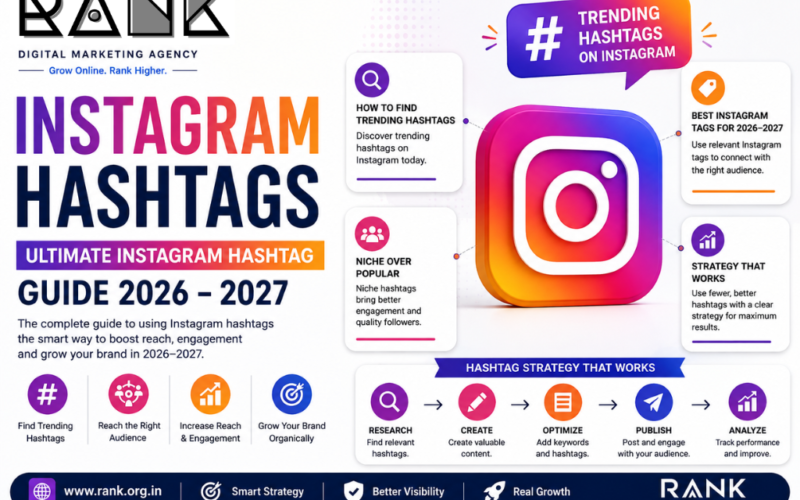
Instagram hashtags are still useful for helping categorize content and connect posts with relevant audiences, but the way creators and businesses should use them has changed. In 2026, simply adding a long list of popular hashtags is no longer an effective Instagram growth strategy.
Instagram increasingly understands content through captions, keywords, videos, on-screen text, engagement and user behavior. Hashtags should therefore support your content strategy rather than replace it.
This Instagram Hashtag Guide 2026–2027 explains how to use hashtags, find trending hashtags on Instagram, choose the right Instagram tags, and build a more effective hashtag strategy.
What Are Instagram Hashtags?
Instagram hashtags are words or phrases preceded by the # symbol. They help categorize posts and make content easier to associate with particular subjects.
For example:
- #DigitalMarketing
- #SEO
- #InstagramMarketing
- #TravelIndia
- #FitnessTips
- #SmallBusiness
- #FoodPhotography
A hashtag tells Instagram what a post is about and can help users discover content related to a particular topic.
However, hashtags are only one part of Instagram discovery. A post with excellent hashtags can still perform poorly if the content doesn’t attract attention or provide value.
Do Instagram Hashtags Still Work in 2026?
Yes, but their purpose has evolved.
Hashtags should no longer be considered a guaranteed way to increase reach. Instead, they can help provide additional context about your content and connect it with a specific topic or audience.
Instagram can now understand much more than hashtags. It can analyze captions, visual content, spoken words, text displayed inside videos and audience interactions.
Therefore, your strategy should be:
Relevant content + keywords + appropriate hashtags + strong engagement
rather than:
More hashtags = more reach
Quality is more important than quantity.
How Many Hashtags Should You Use?
Using a smaller number of highly relevant hashtags is generally a better strategy than filling your caption with dozens of unrelated tags.
For a post, you could create a focused combination such as:
#SEOAgency #SEOServices #SEOPakages #DigitalMarketing #SmallBusinessSEO #DelhiBusiness #FixedPriceSeopackages
Each hashtag has a clear relationship with the subject.
Avoid adding unrelated popular hashtags simply because they have a large audience. Instagram users are looking for relevant content, and irrelevant hashtags can make your content less targeted.
How to Find Trending Hashtags on Instagram
Finding trending hashtags on Instagram isn’t simply about finding hashtags with millions of posts.
A popular hashtag may have enormous competition, making it difficult for your content to stand out.
Instead, search for hashtags related to:
- Your industry
- Your target audience
- Your location
- Your products or services
- Current events
- Seasonal topics
- Popular conversations
- Emerging trends
For example, a digital marketing company should not rely only on #Marketing. More specific hashtags such as #DigitalMarketingStrategy, #SEOForSmallBusiness or #ContentMarketingStrategy may attract a more relevant audience.
The best trending hashtag is not necessarily the biggest one.
It is the one that connects your content with the right audience at the right time.
How to Find Trending Hashtags on Instagram Today
If you’re looking for trending hashtags on Instagram today, focus on current conversations rather than relying on an old hashtag list.
Trends can change quickly.
Check what relevant creators, businesses and influencers are currently discussing. Look at popular posts in your niche and identify recurring topics.
You can also monitor:
- Seasonal events
- Industry news
- Festivals
- Product launches
- Popular challenges
- Cultural events
- Local trends
- Current conversations
Before using a trending hashtag, ask one simple question:
Does this hashtag genuinely relate to my post?
If the answer is no, don’t use it.
Trending Hashtags vs. Niche Hashtags
One of the biggest mistakes Instagram marketers make is using only broad trending hashtags.
Consider these examples:
Broad:
#Marketing
Specific:
#DigitalMarketing
Niche:
#SEOForSmallBusiness
The broad hashtag may have a much larger audience, but the niche hashtag can connect your content with people who have a stronger interest in your subject.
For businesses, niche relevance can be more valuable than massive exposure.
A smaller audience that is genuinely interested in your product or service can produce better engagement and business results than thousands of irrelevant impressions.
How to Use Instagram Tags for Business
Businesses should use Instagram tags to clearly communicate their industry, location, products and audience.
For example, an SEO company could use:
#SEOAgency #SEOConsultant #DigitalMarketingAgency #SEOIndia #SmallBusinessSEO
A fashion business could use:
#IndianFashion #FashionBrand #SustainableFashion #FashionStore #StyleInspiration
A local restaurant could use:
#DelhiFood #DelhiRestaurants #IndianFood #FoodLovers #RestaurantDelhi
The goal is to create a connection between the post and the audience searching for that subject.
Instagram SEO Is Bigger Than Hashtags
Hashtags are useful, but Instagram SEO goes beyond hashtags.
If you want your content to appear for relevant searches, use important keywords naturally throughout your content.
Consider optimizing your:
Profile Name
Clearly explain what you do.
Bio
Include important terms related to your business or niche.
Captions
Write naturally while explaining the topic of your post.
On-Screen Text
Use descriptive words in Reels and videos.
Spoken Content
Clearly communicate the subject of your video.
Hashtags
Use a small selection of relevant Instagram tags.
For example, instead of writing:
“Growing every day 🚀 #SEO #Marketing #Business”
you could write:
“Looking for practical SEO strategies for your small business? Here are five ways to improve your organic visibility and attract more potential customers.”
Then add a few relevant hashtags.
This gives Instagram considerably more context.
Hashtag Strategy for Instagram Reels
Reels should not depend entirely on hashtags.
The opening seconds, content quality, watch time, shares, saves and overall engagement can have a much greater effect on performance.
Use hashtags to reinforce the topic.
For an Instagram marketing Reel, relevant tags might include:
#InstagramMarketing #SocialMediaMarketing #InstagramTips #ContentStrategy #SocialMediaTips
The hashtags identify the subject, while the actual video needs to provide useful or entertaining information.
Common Instagram Hashtag Mistakes
Using Irrelevant Trending Hashtags
Don’t use a viral hashtag just because it is popular.
Using Too Many Hashtags
More hashtags don’t automatically produce more reach.
Repeating the Same Hashtag Set
Create different combinations based on your content categories.
Choosing Only Extremely Popular Tags
Highly competitive hashtags can make it difficult for your content to stand out.
Ignoring Your Analytics
Monitor which content receives views, saves, shares, profile visits and engagement from non-followers.
Using Hashtags Without Strategy
Every hashtag should have a purpose and connection to the content.
The Best Instagram Hashtag Strategy for 2026–2027
A modern Instagram hashtag strategy should follow a simple process:
Research → Create valuable content → Add relevant keywords → Select focused Instagram tags → Publish → Analyze → Improve
Don’t build your entire Instagram marketing strategy around hashtags.
Build it around your audience.
Hashtags should help Instagram understand your content, while your content should give people a reason to stop scrolling.
Final Thoughts
The era of copying huge lists of hashtags and expecting viral reach is fading.
The smarter approach for 2026 and 2027 is to use relevant, specific and contextually appropriate Instagram hashtags alongside strong content and natural keywords.
When researching trending hashtags on Instagram, don’t automatically choose the hashtag with the largest number of posts.
When searching for trending hashtags on Instagram today, focus on trends that are genuinely connected to your audience and subject.
And when selecting Instagram tags, think about relevance first.
The winning formula is simple:
Less hashtag stuffing. More relevance.
Less chasing popularity. More understanding your audience.
Less quantity. More context.
Used strategically, hashtags can remain a valuable supporting element of Instagram marketing and Instagram SEO throughout 2026–2027.