
For years, link building has been one of the most recognizable tactics in SEO. Businesses published guest posts, earned editorial coverage, exchanged links and invested in high-authority placements to strengthen their backlink profiles.
That approach can still contribute to traditional search performance. But AI-powered search is changing the definition of online authority.
A website can have hundreds of impressive-looking backlinks and still fail to become a brand that AI systems confidently recommend.
The reason is simple: AI search needs context and evidence, not just links.
Do Backlinks Still Matter for SEO?
Yes. Backlinks remain useful for traditional SEO when they are relevant, credible and naturally earned.
The problem is treating every backlink as equally valuable.
A link from a highly rated website may look impressive in an SEO report, but its real value depends on several factors:
- Is the website relevant to your industry?
- Does the page have a genuine audience?
- Is your brand discussed naturally?
- Does the surrounding content support your expertise?
- Could a customer discover your business through that mention?
A backlink should therefore be viewed as one part of authority—not the complete definition of authority.
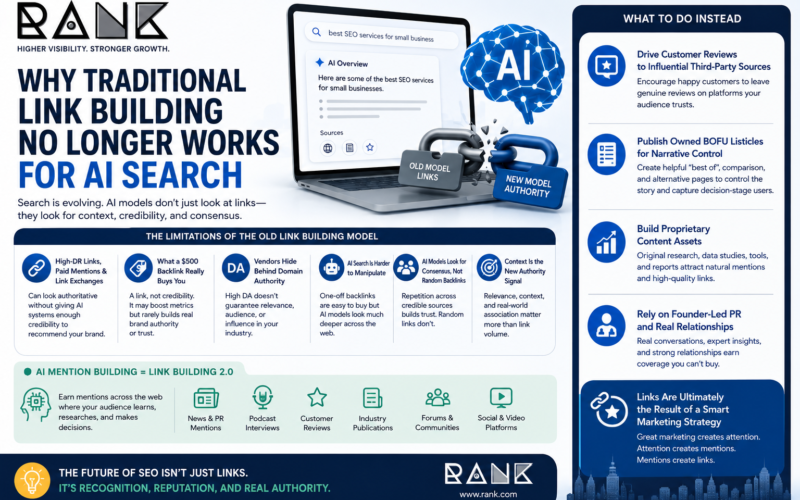
What Does a $500 Backlink Really Buy?
The price of a backlink can create the illusion of value.
A seller may advertise a placement on a website with a high Domain Rating and present it as a premium SEO opportunity. But a high metric does not automatically mean high credibility.
You may receive a hyperlink, but you may not receive:
- Genuine industry recognition
- Relevant referral traffic
- Customer trust
- Expert positioning
- Strong brand associations
- Independent recommendations
The better question isn’t “How much does the backlink cost?”
It is:
“What does this publication actually contribute to the reputation of my brand?”
A $500 link from an irrelevant website may be less valuable than a naturally earned mention from a smaller but highly relevant publication.
Link Building Vendors Often Hide Behind Domain Authority
Third-party metrics are useful for research, but they can become dangerous when they are treated as the final measure of authority.
A campaign promising 50 high-DR links sounds attractive because it produces a clear number.
But numbers don’t explain context.
A website could have a strong backlink profile while having little influence within your particular industry. Conversely, a niche publication with a smaller overall metric could be extremely influential among the people you want to reach.
This is why modern link building should evaluate relevance, audience, editorial quality and context alongside traditional authority metrics.
AI Search Is Harder to Manipulate With One-Off Backlinks
AI-powered search changes the problem further.
When an AI system has to answer a question about a company, it needs to understand more than whether one website links to that company.
It needs to build a picture of the entity.
What does the company do?
What category does it belong to?
What is it known for?
Who talks about it?
What do customers say?
Which publications recognize it?
What topics repeatedly appear alongside the brand?
One isolated backlink cannot answer all those questions.
A broader collection of relevant references can.
AI Models Are Looking for Consensus, Not Random Backlinks
Think about how people establish reputation in the real world.
If one unknown person says a company is excellent, you may remain skeptical.
If customers, industry experts, journalists and independent organizations repeatedly describe the company as excellent, your confidence increases.
AI search faces a similar information problem.
A brand that repeatedly appears across credible sources in connection with a particular topic can develop a stronger digital identity than a brand surrounded by hundreds of unrelated links.
This is why consistency matters.
The goal is not simply to make your brand appear more frequently.
The goal is to make it appear for the right reasons and in the right context.
Context Is the New Authority Signal
Consider two backlinks.
The first comes from an unrelated website and appears in a generic article containing dozens of commercial links.
The second comes from an industry publication discussing your research and explaining why your company is relevant to the subject.
Both are technically backlinks.
But the second tells a much stronger story.
It establishes a relationship between:
Brand → Expertise → Topic → Industry → Recognition
That context can be more useful than simply knowing that one website linked to another.
Modern SEO should therefore focus on building contextual authority.
AI Mention Building Is Link Building 2.0
The next evolution of link building is not necessarily about replacing links.
It is about creating genuine reasons for other people to mention your brand.
A mention could appear in:
- An industry article
- A customer review
- A podcast
- A news story
- A comparison page
- An expert interview
- A community discussion
- A research report
- A professional directory
Some mentions will include links.
Others won’t.
The important thing is that the brand becomes associated with relevant subjects across multiple independent sources.
This can create a stronger digital footprint than a campaign based entirely on purchased placements.
What Should Businesses Do Instead?
Businesses should stop treating link acquisition as an isolated monthly activity.
Instead, link building should become part of a broader authority and marketing strategy.
Drive Customer Reviews to Influential Third-Party Sources
Reviews provide something backlinks cannot easily provide: customer experience.
Encourage genuine customers to leave honest feedback on reputable platforms that are relevant to your industry.
The objective isn’t to manufacture reviews or manipulate ratings.
It is to make genuine customer experiences discoverable outside your own website.
A company repeatedly receiving authentic feedback from real customers develops a much richer reputation than a company with only self-published testimonials.
Publish Owned BOFU Listicles for Narrative Control
Bottom-of-the-funnel content is particularly important because this is where customers compare alternatives and make decisions.
Businesses can create useful resources such as:
- Best solutions for small businesses
- Top providers for a specific industry
- Alternatives to a particular product
- Service comparisons
- Pricing guides
- Buying guides
- “Best of” industry resources
These pages should provide genuine information rather than becoming thin promotional pages.
The advantage is that the business can explain its category, strengths and differentiators in its own words while helping customers evaluate their options.
Build Proprietary Content Assets
If you want other websites to mention your business, give them something worth discussing.
Create information that doesn’t already exist everywhere.
For example:
Original research
Industry surveys
Unique datasets
Market reports
Annual benchmarks
Interactive tools
Calculators
Original case studies
A proprietary asset can become a reference point for journalists, bloggers and industry professionals.
Instead of asking someone to give you a link, you give them a reason to cite your work.
Rely on Founder-Led PR and Real Relationships
Authority is easier to build when real people are behind the brand.
Founders and experts can contribute to industry conversations by:
- Providing expert commentary
- Appearing on podcasts
- Speaking at conferences
- Participating in interviews
- Publishing original opinions
- Responding to journalists
- Building relationships with editors
- Sharing proprietary research
This produces a more natural authority cycle:
Expertise → Relationship → Coverage → Mention → Recognition → Link
The link becomes a consequence of the relationship rather than the entire objective.
Why the Traditional Link Building Model No Longer Works for AI Search
The traditional model is straightforward:
Find a high-DR website → Buy a placement → Get a backlink → Repeat.
The AI-era model needs to be broader:
Build expertise → Create useful assets → Earn attention → Generate credible mentions → Build recognition → Earn relevant links.
This approach takes longer, but it creates something much more difficult to manufacture: a genuine reputation.
AI search is increasingly operating across a web of information rather than looking at isolated links. Modern AI visibility tools are already measuring brand mentions and source presence separately from traditional link presence, reflecting this broader search environment.
Links Are Ultimately the Result of Smart Marketing
The strongest backlinks are often created indirectly.
A company publishes original research.
A journalist discovers it.
The journalist writes about the finding.
Another publication references the research.
An expert discusses it.
Customers discover the brand.
Additional websites begin mentioning the company.
Some of those mentions eventually become backlinks.
That is a fundamentally different approach from purchasing links one at a time.
Good marketing creates attention.
Attention creates discussion.
Discussion creates recognition.
Recognition creates mentions.
Mentions can create links.
Final Thoughts
Backlinks aren’t disappearing from SEO. What is changing is the assumption that more links automatically mean more authority.
In an AI-first search environment, brands need a stronger digital identity supported by relevance, expertise, independent recognition, customer experiences and consistent references across the web.
High-DR links, paid placements and exchanges may improve a backlink report, but they cannot automatically create the reputation required for an AI system to confidently recommend a business.
The future is therefore not about abandoning link building.
It is about moving from link acquisition to authority building.
The best strategy is no longer:
“How many backlinks can we get?”
It is:
“What can we do that makes credible people and publications want to talk about us?”
When the marketing is strong enough, the links become the result—not the strategy.